The Future of UCLA’s Wastewater — Daily Bruin PRIME Magazine Spring 2025
“They can take all that water and inject it back in the ground – so that that water becomes available for the LA community.”
“It was white-owned companies looking out for white workers and ensuring they were going to – oftentimes explicitly – only hire white men.”
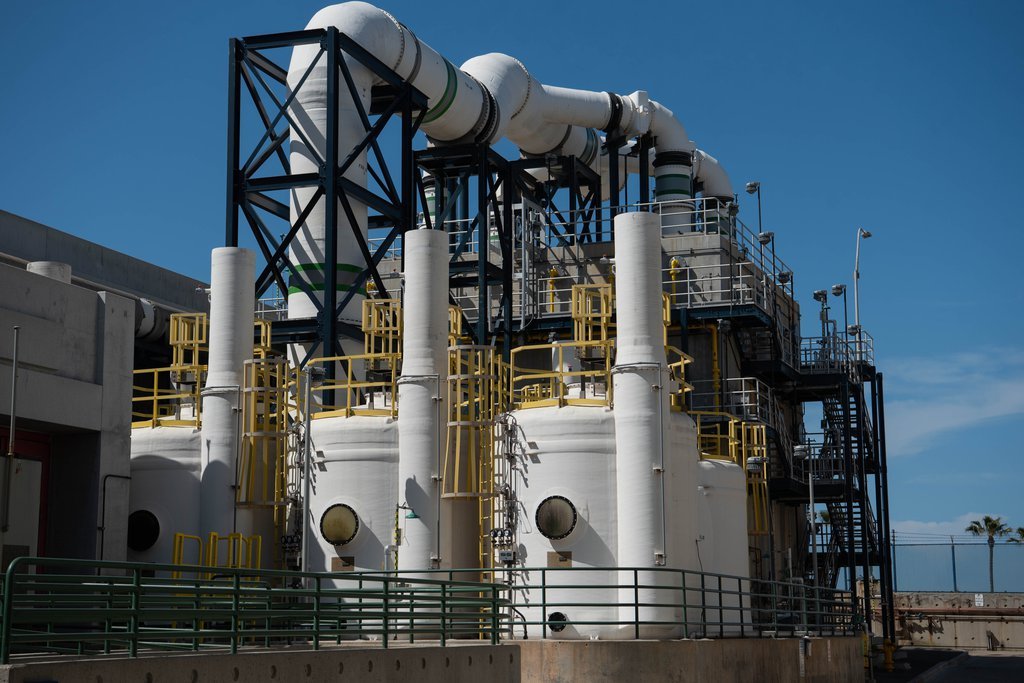
Cranks, clangs and beeps echo off the walls of buildings covered in multicolored, winding pipes. In the distance, Pacific waves crash against the shore as palm trees frame the background of this otherwise industrial landscape. The faint odor of sewage comes and goes with the wind.
Hyperion Water Reclamation Plant sits just next to the Pacific Ocean, right along the Santa Monica Bay. As the largest plant in Los Angeles’ wastewater system, it handles nearly 100 billion gallons of wastewater every year – including all of UCLA’s sewage. This volume includes sewage from LA as well as 29 other cities that send wastewater to Hyperion, where it is treated and sent back into the ocean. But in the next 10 years, instead of being sent back into the ocean, that wastewater will be recycled and used throughout LA. As the city plans to make massive changes to its sewage infrastructure, Hyperion’s role in wastewater recycling will only grow.
These changes raise questions – such as: Who bears the brunt of industrial expansion and waste processing infrastructure? The program’s effects will be felt across the city, helping determine the future of UCLA’s wastewater programs and potentially creating new environmental considerations for the plant’s neighboring community in El Segundo. With Hyperion’s presence in a historically white enclave, its environmental hazards do not fit squarely into typical environmental justice narratives and reveal a hidden history of LA.
Currently, Southern California heavily relies on water imported from the Colorado River and the northern and eastern Sierra Nevada for its drinking water supply, bringing 1.5 billion gallons of water into the region every day. However, as climate change dries up external water sources, LA is considering other collection solutions, such as increasing the amount of wastewater treated and recycled locally. If properly filtered, the wastewater can be used in almost every way groundwater can.
To meet this need, the LA Department of Water and Power and LA Sanitation & Environment have initiated a project called Pure Water LA, which aims to prepare LA for a more sustainable and self-reliant future by helping the city reach its goal of recycling 100% of Hyperion’s wastewater by 2035 and increase local water sources. As the largest wastewater treatment plant in LA, the project will lean on Hyperion to make this large-scale reclamation feasible.
Eric Hoek, a professor in the UCLA Department of Civil and Environmental Engineering and a member of Pure Water LA’s technical advisory board, said Hyperion plans to expand its current wastewater treatment to include infrastructure that supports indirect potable reuse – or the process of making wastewater drinkable. Currently, Hyperion has a small advanced water purification facility that can produce 1.5 million gallons of recycled water daily.
Sanjay Mohanty, an associate professor of civil and environmental engineering at UCLA, said recycling wastewater for broader use would require building new processing facilities such as reverse osmosis infrastructure. Reverse osmosis is a process that removes all pollutants, including sewage particulates, from water through high-pressure straining.
“They do it so that they can take all that water and inject it back in the ground – so that that water becomes available for the LA community,” Mohanty said.
Mohanty said the existing process of sending wastewater into the ocean is wasteful. He instead believes treatment facilities such as Hyperion should recycle wastewater to be used for a wide range of purposes, such as drinking water.
Through Hyperion’s advanced water purification facility, it has slowly begun recycling wastewater using these technologies. Wastewater treated using reverse osmosis and other purifying measures only accounts for less than 1% of Hyperion’s daily sewage output. By expanding this capacity, Hyperion may be able to accommodate LA’s wastewater recycling goals.
But progress toward that expansion is still in its early stages.
“Hyperion hasn’t done any of this yet, but this is all in the works,” Hoek said. “This is over the next 10 to 20 years. They’re going to be implementing in different phases.”
As that transition occurs, UCLA’s wastewater will add to Hyperion’s increased recycling load – but the university may soon pursue a recycling plant of its own, Hoek said.
One of the primary reasons UCLA has considered building its own wastewater recycling plant comes down to infrastructure: There are currently no pipes that can carry Hyperion’s recycled wastewater back to campus.
In turn, this facility would primarily recycle wastewater to cool down UCLA’s power plant. Since the UC Office of the President mandated a 36% reduction of drinking water usage per campus by 2025, Hoek said the only way to reach that goal would be by reducing the amount of water used for the power plant, such as by using recycled wastewater from the dorms. Another benefit of a new recycling plant would be that the facility could house a research laboratory used to test new wastewater treatment technologies and run training programs.
Despite positive feedback on the project over the last 10 years, executing the plan has been challenging.
“LADWP and Sanitation have always supported this project. They’ve always thought it was a great idea, and they want the research facility there and all that,” Hoek said. “They’ve been really wonderful in support – but there has been a movement of, ‘Well, who’s going to own it? Who’s going to pay for it? Who’s going to operate it?’”
Another reason for the delay, Hoek added, is the Pure Water LA initiative, which includes building pipes that send recycled wastewater throughout the city – potentially making a UCLA-specific plant unnecessary.
While the city plans to expand its wastewater recycling efforts, the impact on the surrounding community remains to be seen. If UCLA does continue to rely on Hyperion, it will become one small contributor to this impact.
The El Segundo neighborhood sits directly east of the Hyperion treatment plant. When things go wrong – such as sewage spills and sludge overflows – it is the community that bears the brunt of the environmental fallout. In 2021, Hyperion unintentionally discharged millions of gallons of untreated sewage into the Pacific Ocean, releasing high levels of hydrogen sulfide into the air. Residents felt the effects immediately, with waves of odor pollution sweeping through the community. While the treatment facility has worked to address the spill and reduce odor levels, pockets of El Segundo still reported persistent odors three years later.
Besides Hyperion, El Segundo is surrounded by potential polluters. North of El Segundo is LAX, where particulate matter from aircraft exhaust heavily pollutes neighborhoods within 10 miles of the airport. South of El Segundo is a Chevron oil refinery, which was named by a 2023 study as the worst emitter of several water pollutants among United States refineries. The eastern side of the city borders Interstate 405 – which, because of rampant vehicle traffic, is a source of pollution from vehicle exhaust.
In LA, marginalization and the presence of environmental harm are linked. Across the country, housing policies in the 1930s segregated people of color – particularly Black Americans – to neighborhoods the government deemed less than desirable – areas often exposed to environmental hazards such as pollution. Through redlining, people of color were systematically denied access to better-quality housing, including housing away from hazardous waste sites and other heavy polluters such as oil wells – which has had lasting effects.
While there are oil and gas wells across the county, the majority of toxic release inventory sites are in neighborhoods with predominantly Black and Hispanic residents, such as Huntington Park, Bell Gardens and Compton. According to the U.S. Environmental Protection Agency, these sites can release toxic chemicals into the air, water or land.
But El Segundo does not fit squarely with these trends. Of the more than 17,000 residents in El Segundo, almost 70% of them identify as white, according to 2021 U.S. Census Bureau estimates. Black people make up less than 5% of the population.
Since before Sanitation & Environment and the Department of Water and Power even existed, El Segundo has been a dumping ground. The 200 acres Hyperion currently sits on were initially purchased by the City of LA in 1892 to create the city’s first outfall sewer. Shortly after, workers for what was then known as the Standard Oil Company of California began settling in the city of El Segundo. In 1950, the sewer transformed into a secondary treatment facility, which it still is today.
Because of El Segundo’s close proximity to a sewage waste facility, it would have fit the requirements to be a redlined district. Instead, it only got a yellow grade.
Daniel Cumming – an environmental history postdoctoral fellow at Queens College, City University of New York – said this could be attributed to El Segundo’s historic racial demographics. Much like the rest of the LA Basin, Chevron had racially selective hiring practices.
“Oftentimes, it was white-owned companies looking out for white workers and ensuring they were going to – oftentimes explicitly – only hire white men,” Cumming said. “That’s not to say that Black workers were not also being hired, but … the opportunity was incredibly scarce. It (oil) was almost an entirely white industry.”
Despite this history of segregation, El Segundo stands in contrast to a common pattern across the country of marginalized communities, not white neighborhoods, tending to be surrounded by environmental hazards.
Hyperion has since implemented technologies and practices to limit the impact of wastewater processing on the surrounding community – with multiple contingency plans for heavier sewage flows and any system failures. Besides crisis management, it works to limit the impact of day-to-day operations on El Segundo with odor prevention methods. Even the plant itself does not have an incredibly strong sewage smell.
Not every community impacted by treatment plants has these benefits, however.
Shakira Hobbs, an assistant professor of civil and environmental engineering at UC Irvine, said her family in Dundalk, Maryland, does not benefit from extensive odor management infrastructure – which causes the community to persistently smell like sewage.
“We always know when we’re in Dundalk because of the smell,” Hobbs said. “It smells awful, especially during the summer.”
According to Hyperion’s website, direct community input has led to operational changes. At nearly every treatment point, large white pipes capture foul air, which is then treated in biotrickling filters using microorganisms and carbon polishers to remove pollutants and odors.
These technologies are expensive, with Hyperion’s biotrickling filter infrastructure costing over $21 million to build. As a result, a community’s access to this technology is often dependent on its members’ economic and political power. Hobbs said a community like Dundalk, which is a relatively low-income area, does not have the same odor management technology as El Segundo.
“I don’t believe that technology exists in Dundalk. Dundalk is known to be a smelly town,” Hobbs said. “Maybe that’s where economics or socioeconomics may be playing a role in that (Hyperion’s) infrastructure and preventing how big of a plume that smell may be.”
In this way, Hyperion’s proactive approach to the community differs from other waste-impacted communities across the country and LA.
Despite being so close to many environmental hazards, El Segundo’s property values remain higher than those of some other surrounding communities. In addition to the city having a high-ranking school district and being right on the coast, it is possible that efforts by Hyperion and other facilities to mitigate risk keep prices high.
Tanya Taylor, the founder and executive director of the arts education program Black in Mayberry and a previous resident of El Segundo, said she always marveled at how expensive the city was despite its close proximity to environmental harms.
“One of the big questions I’ve always had when I was there is, ‘Why are the houses here so expensive?’” Taylor said. “That’s really something that’s always blown my mind. And it’s surrounded by waste factories. It’s not a great place to live, environmentally.”
In the four years that Taylor and her family lived in El Segundo, she said she saw its housing prices rise dramatically. Between February 2020 and February 2024, the median sale price of houses in El Segundo jumped from $1.1 million to $1.65 million, according to Redfin. Taylor said she believes the city’s largely white demographic may factor into the high cost of housing.
Comparatively, Hawthorne – which is directly east of El Segundo – typically has a median home sale price less than $1 million, according to Redfin, despite being further from environmental hazards. The city is predominantly Black and Latino.
“I’m certain that if it (El Segundo) had been a predominantly Black, Latino, (or) Asian community, the house prices would never have reached that high – not with those issues that it’s surrounded by,” Taylor said.
From the ground at Hyperion, El Segundo is nowhere in sight. Tucked behind a low hill, the city sits just beyond the 144-acre treatment plant. The machinery clanks on, and the freeway hums without pause – and beyond the ridge, people go about their lives, sharing space with LA’s largest wastewater facility. Though the city may be out of view, the plant’s environmental impacts still linger with the wind.
As Hyperion prepares to expand operations to meet LA’s growing water recycling goals, its impact on the surrounding community may increase as well. The shift from sprawling clarifier pools to advanced treatment systems marks a turning point – one that will likely demand greater investment in odor management and community-first planning. And if UCLA plans to go through with building a treatment plant, it’ll have to consider how to invest in both the infrastructure and the neighborhoods that stand beside it.