Connecting Across Characters
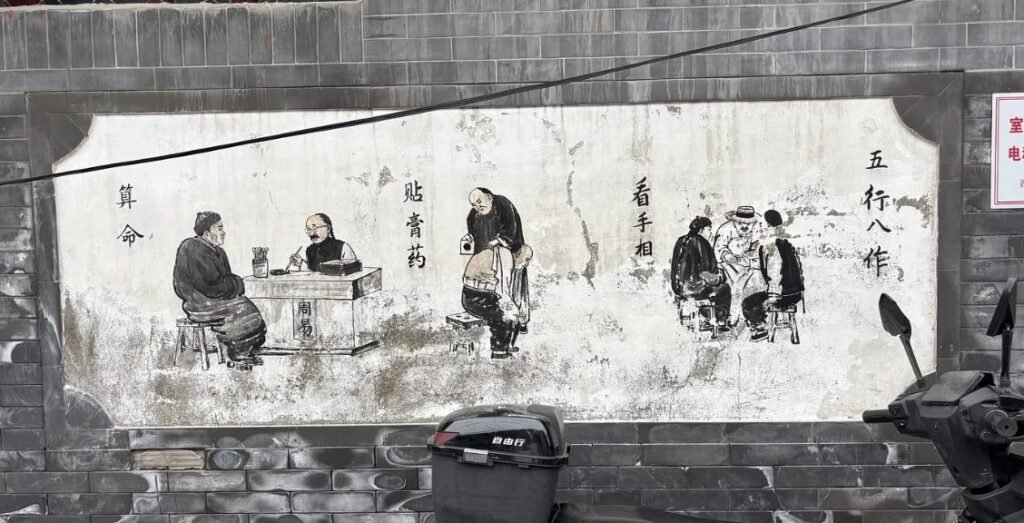
Living in Beijing for the first time catalyzed a series of reflections. Here is just one piece of that puzzle. This is the complete version of a piece originally published in the Daily Bruin.
April 2025
I had never fallen in love with a place in this way.
The city is a mix of old and new. In its center, the Forbidden City is surrounded by both modern malls and single-story sìhéyuàn-style homes that make up the small hútòng alleyways.
These sìhéyuàn-style homes are a type of traditional Chinese architecture, designed to respect the five elements and Confucian values – key facets of Chinese culture.
Inside the hútòng is another layer of juxtaposition: Some sìhéyuàn homes have been converted into modern homes and hotels, while others remain inhabited by families who have been there for generations.
No matter how busy the main streets were, there was always a moment of stillness to be found strolling through the hútòngs in the summer rain, stumbling upon street art and calligraphy stores – even spending the evening in live-music bars.
Outside these moments of quiet, the crowds were fierce.
On the side of Zhōngguāncūn road – the main road separating my dormitory from Peking University’s campus – cars, mopeds, buses, bicycles and swarms of people zoomed past. Even when I was on my way back from a night of eating meat skewers or beef noodle soup, people were always present and in motion.
While I was in Beijing, I received a voice note from one of my roommates describing exiting Union Station in Washington, D.C. during the summer morning rush hour: everyone in suits riding escalators up and out of the beautiful station, almost like a hive, eager to reach their next destination.
Sometimes, that’s how the streets of Beijing felt. At times, it was overwhelmingly crowded and chaotic — everyone eager to reach their next destination. Other times, the crowds swirled so fast they stopped moving. I oscillated between these two extremes — feeling overwhelmed and weirdly at peace.
I found familiarity in the bits of conversations that I could understand, or the smell of yóutiáo and lamb skewers doused in cumin. Much like my experience elsewhere, hearing a sentence or two of pǔtōnghuà or Turkish – the other language I speak – feels like a warm embrace. I am reminded that there are pockets of familiarity and connection to be found no matter where I am in the world.
And just like that, 6,000 miles away from my hometown of San Francisco, I somehow felt right at home.
I traveled to Beijing for the first time with my mother who marveled at the dramatic infrastructure developments from the minute we got in the taxi from the airport to our hotel, and until the moment she left for San Francisco. The last time she was in Beijing was 1999.
The drive from the airport to our hotel in the Chaoyang district was lined with high rise buildings, parks, and malls. None of these existed 25 years ago – the iconic CCTV tower had not even broken ground yet the last time my mom was here.
I marveled at the infrastructure developments, too. Compared to the cities I grew up in, I could zip seamlessly through the city streets on a shared bike – accessible through many of the payment apps that are used daily in China. These bikes are safe to use in a city where protected bike lanes are the norm, not the exception. Every metro station I walked into was air-conditioned and nearly spotless. The buses connected the areas that weren’t as reachable by train, and if you needed a car, a driver from DiDi – a rideshare service – would pick you up in minutes.
The convenience of the city mixed with the buzz of possibility felt fresh in a way my life in Los Angeles and San Francisco did not – these infrastructure elements do not exist at the same scale in the cities I call home.
For the next two months, Beijing became my home. One that, months later, I am eager to return to.
I spent the warm summer months of July and August at Peking University to continue learning hànzì, which are Chinese characters, and the dialect pǔtōnghuà, also known as Mandarin. The reason I make this distinction instead of just saying “Chinese” is that the term “Chinese” is incredibly broad. Within the broader Chinese language, there are approximately seven language groups: Mandarin (pǔtōnghuà), Wu, Min, Yue, Hakka, Gan, and Xiang. Each of these language groups have multiple dialects within them – totaling 284 living indigenous languages. Not only do these dialects differ in pronunciation, they can also differ in grammatical structure, meaning the written form varies. As such, I distinguish my written and spoken education as learning hànzì and pǔtōnghuà.
While I’ve spent my entire life learning pǔtōnghuà, in Beijing, I had to use that skill every day to navigate a place filled with people I had never met. What stuck with me the most during my time in China was how even in the face of language barriers and cultural differences, the people I met from across the world pushed through them to communicate and connect.
To forge those connections, I had to break through other peoples’ perceptions of me. I frequently received prolonged stares and double takes from strangers in the security line at metro stations, while strolling through the hútòngs, at restaurants and at the Great Wall. Children in tour groups would point and yell lǎowài as I’d walk past, or ask to take pictures with me and my American friends.
Some of my peers found this irritating – it was difficult to be invisible and slip in and out of places when you stood out so much, no matter how convenient the transportation infrastructure was. The constant attention triggered, in a number of my friends, a feeling of not belonging.
Sometimes I felt equally out of place. Despite being half-Chinese, despite being fluent in pǔtōnghuà, I stood out from the crowd. But navigating that discomfort is merely a part travel and reckoning with your own worldview.
Once I opened my mouth, the stares and double-takes melted into curiosity almost immediately, even just for a momentary exchange of hellos and where-are-you-froms.
On one occasion, I noticed the little girl I was sitting next to look inquisitively at my friends. Against the hush of the subway, I heard her ask her mother in a whispered voice why one of my friends had blonde hair. Once her mother answered, I leaned over and asked the girl if she could guess where we were from. After we exchanged a few words, her mother whispered to the girl, ”跟姐姐说 ‘欢迎你来到北京!’“ — Tell the older sister, ‘Welcome to Beijing.’
Many of my exchanges with locals started with shock and praise. My friends and I were often praised by strangers for our ability to speak in pǔtōnghuà. Even the little girl on the subway’s eyes widened when I started talking to her.
An off-handed “请让一下” — Excuse me — was met with a slightly shocked “哇,你的中文真好啊” — Wow, your Chinese is so good.
I always found it a little amusing that whispering a few words brought so many compliments. I hadn’t experienced it before. Even when I was meeting other Peking University students who were from China, they repeatedly praised my pǔtōnghuà, impressed that I could keep up with their discussions about politics and their doctoral research.
After too much praise, I embarrassed myself by saying,”你们的中文也很好啊!” — Your Chinese is so good, too!
As this pattern continued, one of my Chinese professors explained that Chinese people in China praised us not out of politeness, but rather out of encouragement. They know firsthand how difficult learning pǔtōnghuà is, so they encourage foreigners to learn in order to pass down the language.
I found this to be true in pockets across the city.
On the final days of my trip, I took myself on a solo shopping excursion in the 798 Arts District.
Amidst the graffitied tunnels and boutique art galleries I stumbled into a store where handmade leather goods were pouring out of the walls. After learning about the shopkeeper’s creative process he praised my fluency in pǔtōnghuà, saying we need more people who can act as bridges between our cultures.
After returning from Beijing, I developed a greater appreciation for the way language can be used to communicate cultural nuances. Given this encouragement, I was all the more motivated to learn.
As someone who has grown up juggling three very different languages at home, learning another language is a matter of trial and error, picking yourself up when you make mistakes and pushing through despite stumbling. Fluency waxes and wanes with your surroundings and the amount of effort you put into practicing. When I don’t have an immersive environment now like I did in Beijing, I find fluency quickly slipping through my fingers.
Understanding hànzì and reading, speaking, and writing in pǔtōnghuà all work different skills. Pronunciation is not always obviously tied to the way individual characters are written. Because there are so many heteronyms in pǔtōnghuà, reading, speaking and listening have additional layers of difficulty. Even mastering over a thousand characters ceases to be effective when you’re confronted with more abstract idioms, colloquialisms and lines of poetry – yet these subtleties are central to mastering the language. To my professor, everything that came out of our mouths sounded like dà báihuà — words that are easy to understand but lack depth and meaning. Teachers and parents often use dà báihuà to critique the overly simplistic language of their students and children.
During this discussion, the issue of using the restroom came up. In pǔtōnghuà, there are multiple ways to announce going to use the restroom. “我去上厕所,” “我去上洗手间” and “我去上卫生间” are, colloquially, the most common. After a month of using these phrases somewhat interchangeably, our professor informed us that, outside of our close social circles and casual settings, our announcements were too direct. Instead, she said that in some contexts it would be better to use “我要去方便一下,” which directly translates to “I am going to take a moment to relieve myself.” To my American English ear, this phrase feels just as direct as the others.
That’s the thing about learning other languages. Translation sometimes fails you.
But perceptions of language are not consistent amongst its speakers, either. During this article’s editing process, the editors who spoke pǔtōnghuà – and their parents – had disagreements over these bathroom-related phrases.
I found these nuances to be elusive at times. When I would try to frame these new concepts in English or Turkish, I would confuse myself even more.
Other languages cannot always concisely express a saying in pǔtōnghuà, as the words are wrapped in cultural and historical significance. A key hallmark of becoming proficient in another language is when you stop rehearsing and translating words in one language into your mother tongue. Once in Beijing, rehearsing my words before I said them felt more difficult than just saying them. It felt so rewarding to have a conversation with someone, later realizing that I was actually thinking in pǔtōnghuà. Even if my sentences lacked idioms and lines of poetry, they flowed more seamlessly.
However, not everyone on my program had the same prior exposure to pǔtōnghuà or hànzì. One of my friends on the program did not know a lick of pǔtōnghuà before landing in Beijing. It was only on his first day in the city that he learned the greeting nǐhǎo — hello. When I first found this out, I was appalled. I could not imagine going to China without knowing at least a few basic phrases to get by. But he found his way quickly, navigating the transportation system, ordering food and making friends.
In his beginner hànzì and pǔtōnghuà courses, students from all over the world had to communicate with each other despite not always speaking the same language. One of his classmates did not speak English, but between their limited pǔtōnghuà, translation apps and hand gestures, they were able to understand one another.
While my friends and I struggled to battle the seemingly never-ending complexity of pǔtōnghuà, I learned that the struggle worked the other way too. Over beef noodle soup in the Zhōngguāncūn plaza shopping mall, my language partner told me how she found English difficult to learn. For her, the way hànzì are strung together feels more intuitive.
In hànzì, many individual characters are composed of semantic elements that indicate the meaning of the word while the phonetic component provides a hint for the pronunciation of the word. When strung together with another character, words are organized into more explicit categories. For example, words like liver (肝脏), heart (心脏), kidney (肾脏) and lungs (肺脏) all share the character for organ, zàng (脏). That being said, some characters also falsely hint at pronunciation – there are not always cut and dry rules in any language, let alone pǔtōnghuà.
At least we were in the confusion together.
Almost everyone I came across during my time in Beijing pushed through that common struggle. Instead of running from it, we embraced awkwardly stumbling through an explanation if it meant bridging that cultural gap. If I had not partaken in the struggle, I would not have shared the moments that made this trip stand out to me so much.
I would not have spent an afternoon eating Húběi cuisine’s famous lotus root soup while discussing the differences between Chinese and American politics and values. I would not have discovered hole-in-the-wall local restaurants around Niú Jiē, the Muslim quarter of Beijing, or spent countless hours overlooking the lakes of Shíchàhǎi exchanging life stories and dreams for the future. I would not have spent my weekends watching Chinese indie bands perform and playing card games in bars around the Gǔlóu area. I would not have made friends with people from all across the world who I look forward to reconnecting with when I travel next.
On the final night of the trip, my friends from the UCEAP program and our new friends from Beijing had one last meal together. Inside a private dining room, around a giant Lazy Susan table, the room was filled with the smell of steamed fish, sauteed vegetables, sizzling meats, fragrant noodles and báijiǔ, a type of liquor made from fermented sorghum typically served with food. Since we could not drink báijiǔ without raising a toast, we each took a turn to say a few words, thanking each other for the friendship and memories that have shaped the last two months.
When it came time for our friends from Beijing to raise a glass, idioms and lines of poetry flowed out of their mouths like running water. Poetry is an essential part of Chinese language and culture, and the nuggets of wisdom offered by Chinese poets are often used regularly in conversation or to toast new friends and old. One of them used a line from a poem by a Tang dynasty poet named Wáng Bó (王勃) states, “海内存知己,天涯若比邻” — For friends who intimately know your heart, even across long distances, we’ll still feel like neighbors.
Wáng Bó’s wise words ring true, but I never would have heard them if I let discomfort swallow me into paralysis. The initial discomfort and frustration with the limitations of my own language skills was a very small price to pay for these shared moments of connection.
Now looking back months later, when my use of WeChat has dwindled and my proximity to good jiānbings has certainly decreased, I find myself itching to go back to Beijing. Back in Los Angeles, I take what I can get: watching travel vlogs and Chinese TV shows, brushing up on my language skills when I can, frequently listening to the podcasts on the Sinica Network, and reading the rich descriptions of China during the rapid transformation of the ‘90s and 2000s in Peter Hessler’s books.
I have found myself more motivated to understand, not just the language and culture of my ancestors, but where China and Chinese culture sit in the context of our changing world. That summer spent in Beijing was a turning point for me, and I am all the more eager to explore.